Dutching in Horse Racing: How to Stake Multiple Selections for Equal Profit
 Available in US
The name comes from Dutch Schultz, a 1930s New York gangster who reportedly used the system to launder money through horse racing. The history is murky and possibly apocryphal. What isn’t apocryphal is how often Dutching shows up in the actual P&L spreadsheets of modern UK punters who treat their betting as a serious pursuit.
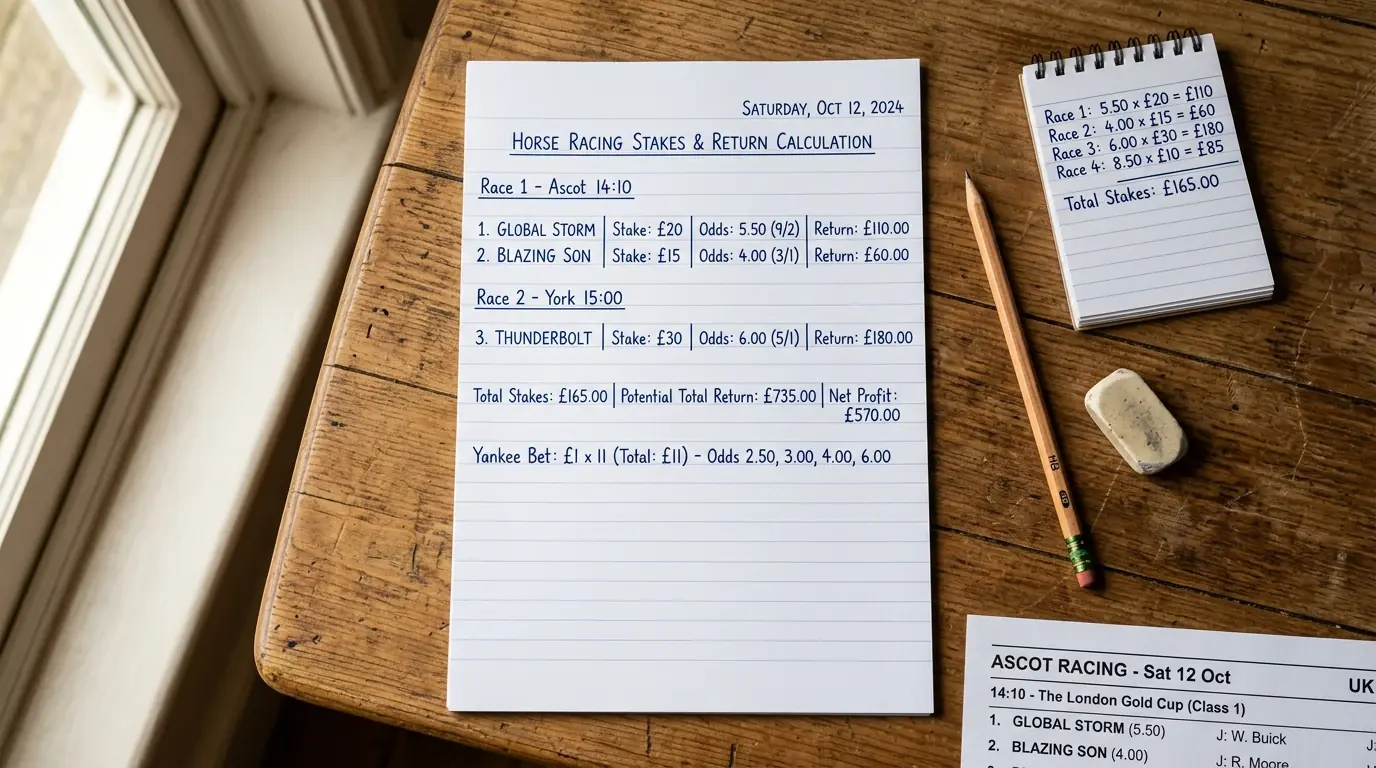
Dutching is the practice of backing two or more horses in the same race, sized so that whichever wins, your profit is identical. Done right, it converts the question “which horse will win?” into the much easier question “is one of these three horses likely to win?” The maths is unforgiving but learnable, and the strategy genuinely shifts certain races from impossible-to-call to bettable-with-an-edge.
This article shows you how Dutching actually works, the formula for splitting stakes for equal returns, the race types where Dutching has a real statistical edge, and how the strategy plays out differently on Betfair Exchange compared to bookmakers.
How Dutching Works and When to Use It
Picture an eight-runner handicap on a Saturday at Doncaster. You’ve done the form. You can confidently rule out five of the eight runners. The remaining three look genuine contenders, each priced between 4/1 and 7/1, and you cannot pick between them for love nor money. This is the moment Dutching exists for.
The standard approach for a beginner would be to either bet the one you fancy most (and accept a 67% chance of being wrong), or to back all three with equal stakes (and find that two of them winning gives you a smaller profit than the third). Dutching solves the second problem. By varying the stake across selections in inverse proportion to their odds, you arrange the bets so that any one of them winning produces the same return.
The strategy works best when you genuinely believe a defined group of horses contains the winner — say two to four runners — and the market hasn’t priced any of them as the obvious choice. It works less well when one of your selections is a short-priced favourite, because the maths forces you to stake heavily on it, which defeats the purpose of spreading risk. And it actively works against you if you’re using it as a security blanket — backing extra horses you don’t really believe in just to “cover” the race.
The clearest signal that Dutching is the right tool: you’ve narrowed the field to a manageable group, the prices on those selections sum to less than 100% implied probability (more on this below), and you genuinely cannot rank them with conviction. If any of those three conditions is missing, single bets serve you better.
The Dutching Formula: Calculating Stakes for Equal Returns
The maths is straightforward once you’ve seen it. The principle: each selection’s stake should be proportional to its implied probability of winning, scaled so that the sum of all your stakes hits your target total.
Let’s walk through a worked example. Three horses, priced at 4.0, 5.0, and 8.0 (decimal). Your total bankroll for the race is £100.
Step one: convert each price to implied probability. 1 divided by 4.0 = 0.25 (25%). 1 divided by 5.0 = 0.20 (20%). 1 divided by 8.0 = 0.125 (12.5%). The total: 0.575, or 57.5%. Because this total is below 100%, the bet has the potential to be profitable.
Step two: calculate each horse’s share. Horse A: 0.25 divided by 0.575 = 43.5%. Horse B: 0.20 divided by 0.575 = 34.8%. Horse C: 0.125 divided by 0.575 = 21.7%. These percentages tell you what proportion of your £100 goes on each.
Step three: assign the stakes. Horse A: £43.50. Horse B: £34.80. Horse C: £21.70. Total: £100.
Step four: verify the return. If Horse A wins at 4.0, you collect £43.50 × 4.0 = £174. Subtract your £100 stake: £74 profit. If Horse B wins at 5.0, you collect £34.80 × 5.0 = £174. Profit £74. If Horse C wins at 8.0, you collect £21.70 × 8.0 = £173.60 (small rounding). Profit £73.60. Whichever wins, you walk away with around £74 in profit. If none of the three wins, you lose your £100.
The key insight is in step one. When the combined implied probability of your selections is below 100%, Dutching produces a profit no matter which of them wins. When it’s above 100%, you’d be locking in a guaranteed loss before the race even starts. That single check — does my selection group’s total implied probability stay below 100% after accounting for bookmaker overround? — is the entire viability test.
Most online Dutching calculators will do this maths in five seconds. I still recommend doing it manually a dozen times before you trust a calculator. The intuition you build is more valuable than the time saved.
Identifying Races Where Dutching Has an Edge
Not every race is a Dutching opportunity. In fact, most aren’t. The structural conditions you’re looking for relate to field competitiveness, market pricing, and the predictability of the favourite.
Big-field handicaps are the first place I look. With 14, 16, or 20 runners, market opinion is genuinely split, and you’ll often find three or four credible contenders priced between 5/1 and 10/1. In UK handicap racing the favourite wins around 25.7% of the time — meaning 74.3% of handicaps are won by a non-favourite. That statistic alone tells you why Dutching can work: in three-quarters of these races, the obvious bet loses, and the winner comes from a wider group.
The second condition is the form profile. You want races where your group of selections each has a clean recent run, a suitable trip, and proven ability on today’s going. If you’re including a horse with messy form just to make the maths work, you’re forcing the situation. Conversely, the second favourites in UK racing win about 20% of races and the third favourites between 12 and 15% — so a Dutching combination of the second and third favourites alone has historically connected in roughly 32 to 35% of races. With prices typically in the 4/1 to 7/1 range for these slots, the maths can work without needing to add a longshot.
The third condition is a vulnerable favourite. Dutching becomes attractive when you’ve identified that the market leader is overpriced — too short for their actual chance. In that scenario, you skip the favourite entirely and Dutch the second, third, and fourth in the market. The combined implied probability often drops well below 100% in this configuration, giving you a healthy margin if any of your three connects. For more on spotting these spots, see my breakdown of the horse racing accumulator strategy, which uses similar value identification principles.
Dutching on Exchanges vs Bookmakers
Where you place your Dutching bets matters more than most people realise. The combined overround is the silent killer of the strategy.
On bookmakers, the overround per race typically sits between 110% and 125%. When you Dutch three horses, you’re effectively absorbing that overround across all three selections. A £100 Dutching bet at a bookmaker carrying a 115% overround is mathematically equivalent to spotting the house a 15% margin before any horse runs. The strategy still works if your edge on the selections is large enough, but the headwind is meaningful.
Betfair Exchange runs differently. The exchange shows new bets matching roughly every 50 seconds in a typical UK racing market, with average market depth of about 9.86 participants. Overround on liquid exchange markets is much lower — often 102% to 105% in the minutes before the off. That’s a 10 to 13 percentage point swing in your favour compared to bookmaker pricing, before you even start. The trade-off is the 2 to 5% commission charged on net winnings, which slightly erodes the advantage but doesn’t reverse it.
My standing rule: Dutch on the exchange unless one of my selections is materially shorter at a specific bookmaker because of a price boost or early-market mispricing. Mixing sources is fine — you can back one selection at the bookmaker’s bigger price and the other two on the exchange. The bet slip becomes manual rather than automated, but the maths is the same. Just remember to recalculate after every price change before you submit, because exchange prices move continuously.
One practical tip: if you’re new to Dutching, place a small dummy bet on paper for a full week before risking real money. Calculate the stakes, record the prices, watch the result, and reconcile what you would have made or lost. Six or seven dummy weeks will teach you more about the strategy than this article ever could.
When Dutching Beats Single Bets
The honest answer is: not as often as enthusiasts claim, but more often than sceptics suggest. The crucial test is whether your edge on the group of selections is larger than the edge you’d have on the strongest single bet within that group.
If you genuinely cannot separate three horses, and your combined implied probability is below 100%, Dutching is the rational play. If you can rank those three with reasonable confidence, betting your top pick at a single price almost always offers better long-term value, because you concentrate your stake on your highest-conviction selection.
The strategy isn’t a magic bullet. It’s a tool for one specific situation: genuine uncertainty between a small group of contenders, in a race where the favourite isn’t dominant. Used in those races, on the exchange, with proper stake sizing, Dutching is a credible part of a wider strategic approach. Used as a catch-all to feel safer, it just multiplies your overround exposure across more horses and accelerates losses.
What is Dutching and how do I calculate the stakes?
Dutching is backing two or more horses in the same race with stakes sized inversely to their odds, so any winning selection produces the same profit. Calculate by converting each price to implied probability (1 divided by decimal odds), dividing each horse’s probability by the group total to get its stake share, then multiplying that share by your total bankroll for the race.
Does Dutching work better with three or four selections?
Three selections is generally the sweet spot. With four or more, the combined implied probability often exceeds 100%, which locks in a guaranteed loss. Three carefully chosen contenders in a big-field handicap typically keep you below 100% while still covering a realistic range of winners.
Can I use Dutching on Betfair Exchange?
Yes, and the exchange is generally the better venue for Dutching because overround on liquid markets is much lower than at bookmakers, typically 102% to 105% versus 110% to 125%. The 2 to 5% commission on winnings slightly reduces the advantage but the underlying maths still favours exchanges for multi-selection strategies.
Published by the Horse Racing bet Strategy team.