
Flat Racing vs National Hunt: How Betting Strategy Differs Between Codes
 Available in US
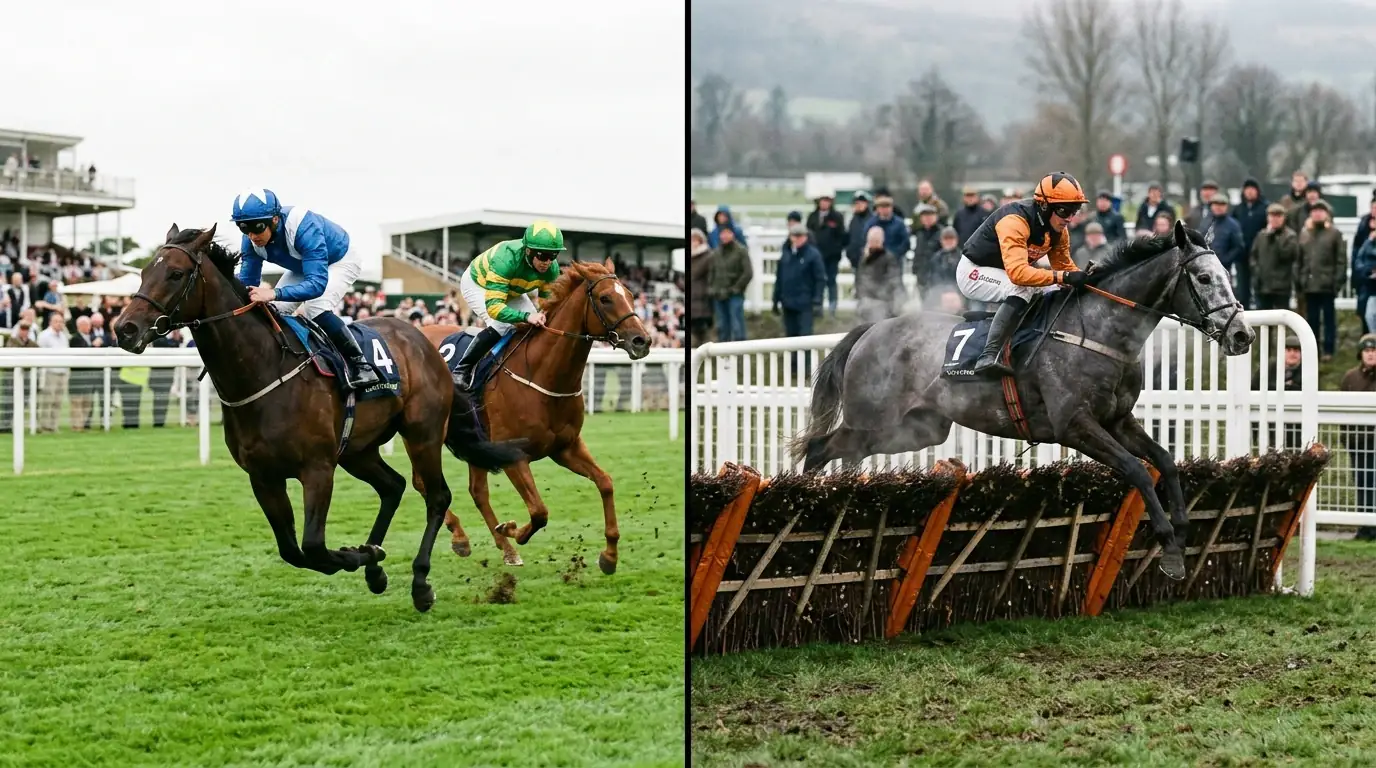
One Friday in November 2018 I had two big bets going on the same afternoon — a 4/1 sprinter at Lingfield on the all-weather and an 11/2 chaser at Wincanton. The sprinter won by a head in a photo. The chaser was leading three from home when he fell. Same stakes, same conviction levels, completely different outcomes — and a useful reminder that the two codes of British racing reward different kinds of analytical work and different kinds of risk tolerance. Treating “horse racing” as a single category, when you’re actually navigating two distinct sports, is one of the slow-burn mistakes that costs UK punters real money over time.
British racing is the second-largest spectator sport in the country by attendance, employment and revenues, and that scale supports a year-round programme split between flat and National Hunt. Each code has its own season, its own training calendar, its own roster of elite trainers and its own form patterns. A punter who treats them as interchangeable is leaving structural edge on the table; a punter who specialises in one or both with awareness of how they differ is operating on more solid ground.
This article walks through the key differences between flat and National Hunt racing, the betting considerations specific to each code, and the seasonal calendar that determines when each one offers more value.
Key Differences Between Flat and National Hunt Racing
Start with the obvious physical difference. Flat racing has no obstacles. Horses run on level turf or all-weather surfaces over distances from five furlongs (about a kilometre) up to two and a half miles, with the bulk of races between six furlongs and a mile and a half. The races are short — most flat races are over in 90 seconds to two minutes — and the emphasis is on cruising speed, tactical positioning and turn of foot.
National Hunt racing involves obstacles. Hurdles are smaller, around three and a half feet high and built to flex when struck. Chase fences are larger, four and a half feet plus, with open ditches and water jumps at major tracks. Distances start at two miles and extend to four and a quarter miles for the Grand National. Stamina, jumping ability and the capacity to negotiate obstacles cleanly all matter alongside speed. National Hunt races run three to ten times longer than equivalent flat races, giving more opportunity for tactical errors and more variance in outcomes.
The horses themselves differ. Flat horses are typically younger — many are two or three years old, with peak careers often concentrated between three and five. Their physical type favours speed over robustness. National Hunt horses are older — geldings dominate the code, careers extend well into double-digit ages, and physical type favours scope, stamina and durability. The bloodlines overlap less than casual punters assume; specialist flat sires rarely produce successful chasers, and vice versa.
The competitive structure differs too. Flat racing has its own Group classification (Group 1, 2, 3 and Listed) and a Classic series (the 2,000 Guineas, 1,000 Guineas, Derby, Oaks and St Leger) that defines the top of the sport. National Hunt has its own Grade structure (Grade 1, 2 and 3) with the Cheltenham Festival in March representing the apex — the Gold Cup Day peak audience reaches 1.8 million viewers and the Festival programme draws international attention. The training stables tend to specialise in one code or the other, with relatively few yards genuinely competitive across both.
The implication for punters is that the analytical work doesn’t transfer cleanly. The skills of reading flat form lines, draw bias, sectional times and class progressions are different from the skills of reading National Hunt form, jumping records, stamina patterns and chase technique. A punter who knows flat racing inside out may have no genuine edge on National Hunt cards, and vice versa.
Betting Considerations Specific to Flat Racing
Flat racing rewards specific analytical disciplines that don’t apply, or apply differently, in National Hunt betting. Recognising these is the foundation of competent flat-racing strategy.
Draw bias is the first major consideration unique to flat racing. The starting stall position can have a substantial effect on outcomes, particularly in sprints and in races on tracks with sharp turns. Some courses (Chester, Beverley, Wolverhampton) show consistent draw effects that repeat across multiple seasons. Reading the draw at each track is fundamental analytical work for flat punters in a way that simply doesn’t apply at National Hunt meetings.
Sectional times are more reliable and more widely available on the flat than over jumps. Timing technology produces clean furlong-by-furlong splits on flat surfaces, and the closing sectional rank is one of the most useful indicators of how a horse actually performed beyond their finishing position. Sectional analysis on jumps racing is less clean because jumping introduces timing variability, and the data isn’t always captured consistently.
Class progressions matter more in flat racing than National Hunt. The flat programme has a tight class structure (Class 1 down to Class 6 or 7 in handicaps, plus Group races at the top), and trainers actively target specific class levels for their horses. A horse dropping from Class 2 to Class 4 is moving against substantially weaker opposition; a horse stepping up two classes is being asked a much harder question. Tracking class moves is core analytical work.
The all-weather circuit adds a year-round flat dimension that has no National Hunt equivalent. Six UK tracks — Lingfield, Wolverhampton, Newcastle, Kempton, Chelmsford and Southwell — run synthetic-surface flat racing throughout winter and supplement the turf calendar in summer. The all-weather markets are typically softer than equivalent turf cards because casual money concentrates elsewhere, producing genuine value for analytical punters who do the work.
The 30 to 35% favourite win rate that applies broadly across UK racing sits closer to that average on the flat, with handicap favourites dropping to about 25.7%. Flat handicaps with large fields are particularly punishing for casual punters relying on favourite-backing, but they offer some of the best value to punters who do detailed form work.
National Hunt: Stamina, Jumping Ability and Ground
National Hunt rewards a different set of analytical priorities. Stamina, jumping technique and ground conditions dominate the picture in ways they don’t on the flat.
Stamina becomes a primary variable because races run two to four miles or longer. Some horses are bred to stay; others have natural distance limits regardless of conditioning. The form record reveals stamina patterns clearly — a horse with multiple wins at three miles but second-and-third placings at two and a half miles is telling you stamina is their strength. The Grand National’s four and a quarter miles tests stamina at the extreme, and horses without proven form at three miles five furlongs or longer represent genuine stamina risk regardless of their other qualities.
Jumping ability is the variable that doesn’t exist in flat racing. Two horses with similar form figures can have dramatically different jumping profiles, and the difference often decides races. The form figures show position; the race comments in the racing press reveal how the horse jumped. Phrases like “fluent at his fences,” “made a mistake at the third,” “missed and lost ground” build the picture over time. A horse described consistently as fluent and accurate is qualitatively different from one whose comments repeatedly note errors.
Ground conditions affect National Hunt outcomes more strongly than flat outcomes. Heavy and Soft ground dominate the winter calendar, and the stamina demands amplify on testing surfaces. A horse who stays well on Good ground may not stay the same trip on Heavy ground because the surface drains energy faster. The interaction between distance and going matters more in National Hunt than anywhere else in UK racing.
The three disciplines within National Hunt — hurdles, chases and bumpers — each have their own analytical patterns. Hurdles are technically easier than chases and produce more consistent form. Chases introduce higher variance because the bigger fences punish jumping errors more severely. Bumpers (National Hunt flat races for inexperienced horses) produce the hardest form to read because the field consists of horses with minimal prior racing.
The festival peaks of National Hunt — Cheltenham in March, the Grand National at Aintree in April — concentrate pricing in ways that make value harder to find at the headline events. Midweek winter cards at Ludlow, Catterick, Wetherby, Carlisle and the smaller jumps tracks typically offer softer markets where committed analytical work pays off more consistently.
Seasonal Calendar and When Each Code Offers More Value
The two codes operate on overlapping but distinct calendars. Understanding when each one is in its prime phase, and when each one is producing softer or sharper markets, shapes where to direct analytical attention across the year.
The flat turf season runs roughly from late March to early November, with the elite period concentrated between Royal Ascot in June and the Champions Day at Ascot in October. The all-weather flat season runs year-round, with peak activity through winter when the turf programme contracts. The flat year delivers its biggest competitive cards in summer, when markets are deepest and competition for prices most intense.
The National Hunt season runs October to April with the major action concentrated between Christmas and the Cheltenham Festival in March. Summer jumping continues at a few tracks but with thinner fields and reduced quality. The peak audience moments come in March and April, with Cheltenham Festival’s 1.8 million viewers on Gold Cup Day and Royal Ascot drawing 5 million across five days — racing’s biggest audience numbers cluster around these festival peaks.
The participation patterns from the Gambling Survey for Great Britain reveal seasonal shifts. Wave 2 (April-July 2025) captured a 7% participation rate among UK adults — the peak of the spring racing calendar overlapping the Cheltenham Festival and the early flat season. Wave 3 (July-October 2025) showed participation falling to 4% as the headline events passed. The same pattern repeats each year, with the casual betting audience concentrated around the festival peaks and contracting through the routine programme.
The strategic implication for punters: casual money is heaviest at festival times and on Saturday cards. Value tends to concentrate at midweek meetings and during the off-peak periods of each code. A National Hunt punter who specialises in November-December cards before the Christmas peak typically finds softer markets than one who concentrates exclusively on Festival weeks. A flat punter who works the all-weather circuit through winter operates in markets with less competitive pricing than the summer Saturday spotlight events.
The cross-code option matters too. The few months between the end of the turf flat season in November and the start of the major Christmas jumps programme provide a quieter analytical window where careful punters can do background research on both codes’ upcoming campaigns. For deeper context on how to approach UK racing from a beginner’s perspective with these code differences in mind, my full guide to horse racing betting for beginners UK walks through the practical first steps.
Choosing Where to Focus
The decision of whether to specialise in flat racing, National Hunt or both depends on the analytical work you find most engaging and the seasons you can commit to consistently. Punters who try to bet both codes at the same intensity year-round typically dilute their edge in both. Punters who specialise — by code, by season, by race type within a code — concentrate their work where it produces returns.
The two codes will continue to converge in some ways (year-round programmes, growing operator integration, common regulatory framework) and diverge in others (training specialisation, distinct horse populations, separate competitive structures). The punters best positioned to extract value from both ends of British racing are the ones who recognise the differences explicitly and choose where to invest their time accordingly.
Is flat racing or National Hunt more profitable for betting?
Neither code is structurally more profitable than the other — the available edge in each comes from how well your analytical work fits the demands of that code. Flat racing rewards draw analysis, sectional times, class progressions and tactical positioning. National Hunt rewards stamina analysis, jumping technique reading and ground-condition interpretation. Punters who specialise typically produce better long-run results than punters who spread attention thinly across both.
How does the all-weather season affect flat racing betting?
The all-weather circuit provides year-round flat racing across six UK tracks, supplementing the turf calendar through winter. All-weather markets are typically softer than equivalent turf cards because casual money concentrates on Saturday turf meetings, leaving analytical punters facing less competitive pricing pressure midweek. Surface-specific form (Polytrack, Tapeta and fibresand each play differently) and consistent draw bias patterns at all-weather tracks create exploitable angles that the broader market often underweights.
Published by the Horse Racing bet Strategy team.