Horse Racing Betting Glossary: 80+ Terms Every UK Punter Should Know
 Available in US
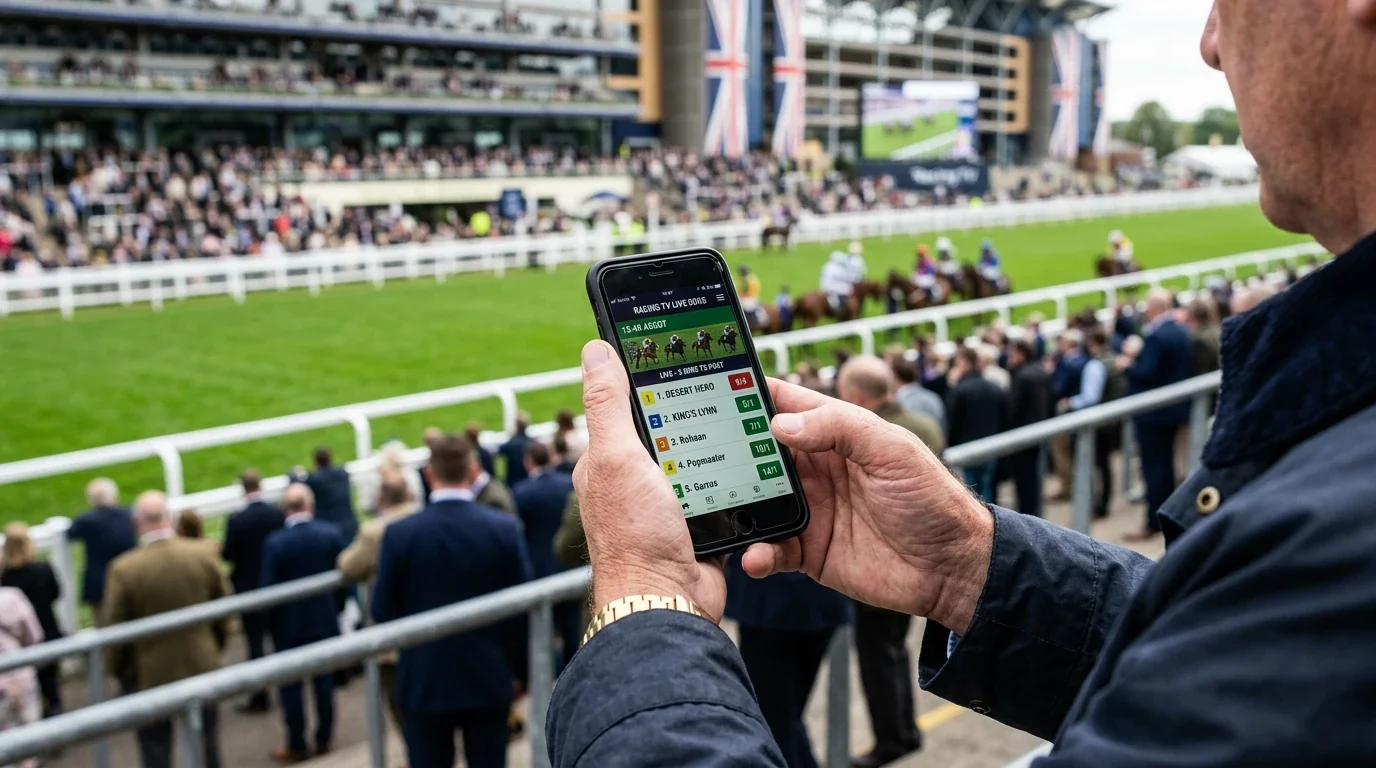
Halfway through my second year at the races a friend asked what “BSP” meant on the racing app I had open. I rattled off “Betfair Starting Price” without thinking, and only afterwards realised that two years earlier I’d had absolutely no idea what it meant either. The vocabulary of UK horse racing builds up so gradually that nobody notices the moment they crossed from confused to fluent. Until you start trying to explain it, and then you realise the language has its own internal logic that nobody ever wrote down for newcomers in one place.
This glossary covers the terms you’ll encounter regularly across UK racing — on racecards, in commentary, on bookmaker apps, in stable yards and in conversation with anyone serious about the sport. The definitions are written to be useful at the moment you actually need them, not exhaustively academic. Where a term has nuance that matters, the entry includes the nuance. Where it’s straightforward, the entry stays brief.
A–D: Accumulator to Dutching
The opening section of the glossary covers the bet types and analytical concepts you’ll meet most often during the first weeks of serious engagement with UK racing.
Accumulator (also “acca”): a multi-leg bet where every selection must win for the bet to pay. Winnings from each leg roll on to the next. A six-fold acca on horses at 2/1 each pays around 728/1 if all win. The overround compounds across every leg, making accumulators structurally expensive across large samples.
Ante-post: a bet placed before final declarations, sometimes weeks or months in advance. Ante-post backers typically get longer prices than will be available closer to the race, but accept the risk that the horse may not run.
Backing: placing a bet on a horse to win. The opposite of laying.
Best Odds Guaranteed (BOG): a bookmaker concession where if you take a price and the SP is higher, you’re paid out at the higher price. The 2026 Remote Gaming Duty rise will pressure these concessions.
Bookmaker (also “bookie”, “sportsbook”): an operator that takes bets at fixed odds. The structural overround on UK bookmaker markets typically sits at 110% to 125%.
BSP: Betfair Starting Price. The exchange equivalent of SP, calculated from matched volume across the exchange at race-off time. BSP usually returns prices slightly better than fixed-odds SP because the exchange overround is dramatically narrower (102 to 105% versus 110 to 125%).
Bumper: a National Hunt flat race for inexperienced horses, run without obstacles. Bumpers serve as the introduction to racing for many young jumpers.
Chase: a National Hunt race over fences, larger than hurdles. Fences are typically four and a half feet plus, with open ditches and water jumps.
Class: the official quality rating of a race, from Class 1 (highest, including Group races) down to Class 7.
Closer: a horse who races at or near the back of the field through early stages, producing a finishing kick in the last few furlongs.
Combination forecast: a forecast bet covering all possible permutations of two or more horses for first and second. Cost rises with permutations.
Decimal odds: odds expressed as total return per unit staked, including stake. 4.00 returns £4 for every £1 staked.
Drifter: a horse whose price lengthens significantly before the race, indicating market support has weakened.
Dutching: backing multiple selections in the same race with stakes calculated to produce equal profit regardless of which one wins.
E–L: Each-Way to Longshot
The middle alphabetical band covers the structural terminology of British racing — from the place-and-win mechanics of each-way betting through to the running styles and form-figure conventions that shape every race assessment.
Each-way (E/W): a two-part bet — half the stake goes on the horse to win, half on it to place. Place terms and place positions vary by race type.
Evens (1/1): odds where you win the same amount as you stake, plus stake back. Decimal 2.00. The pivot between odds-against and odds-on.
Exacta: predicting the first two finishers in correct order. The British version is more commonly called the “straight forecast.”
Exchange: a peer-to-peer betting marketplace where punters back and lay against each other. Betfair is the largest UK exchange; Smarkets and Betdaq operate in the same space.
Favourite: the horse with the shortest odds in the betting market. UK favourites win 30 to 35% of races overall, with handicap favourites at about 25.7%. Odds-on favourites on flat turf win approximately 59%.
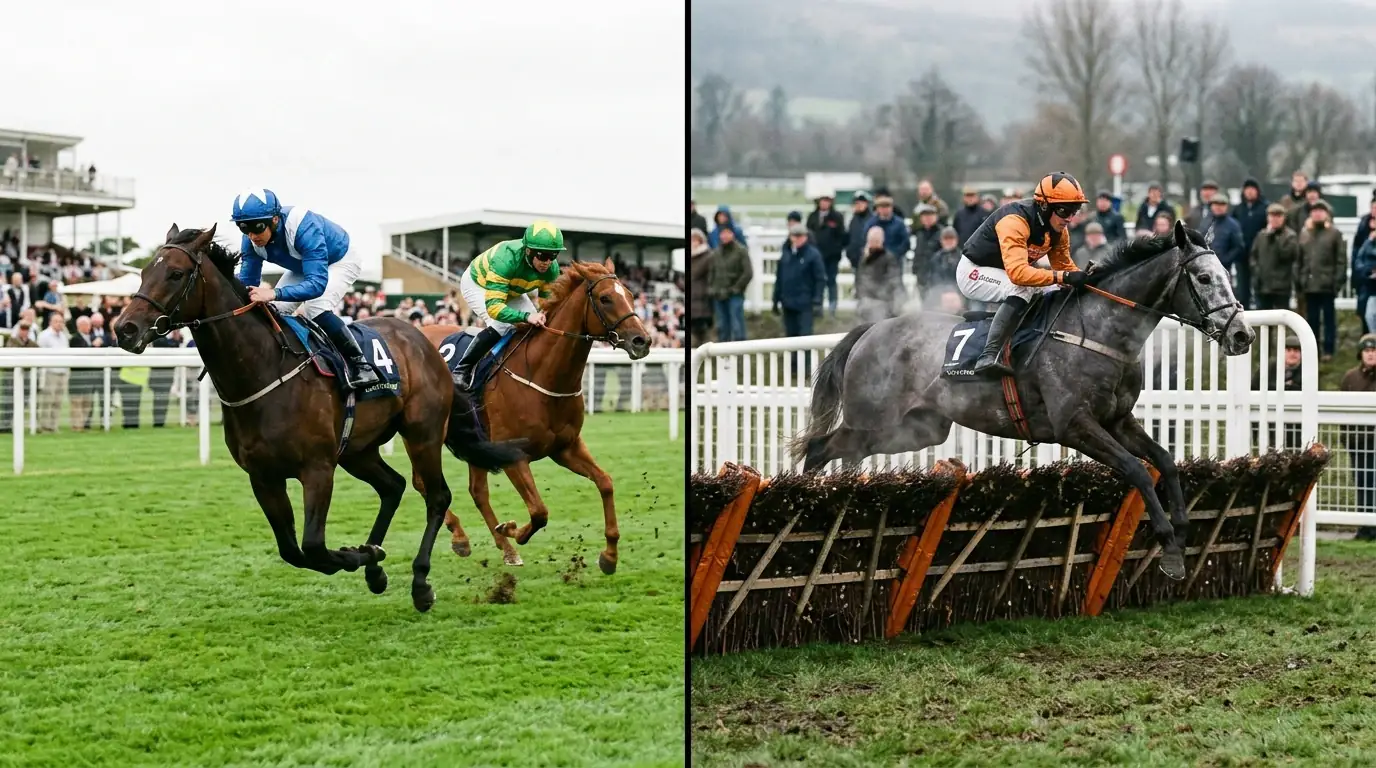
Flat racing: racing on level turf or all-weather surfaces without obstacles. Distances range from five furlongs to two and a half miles.
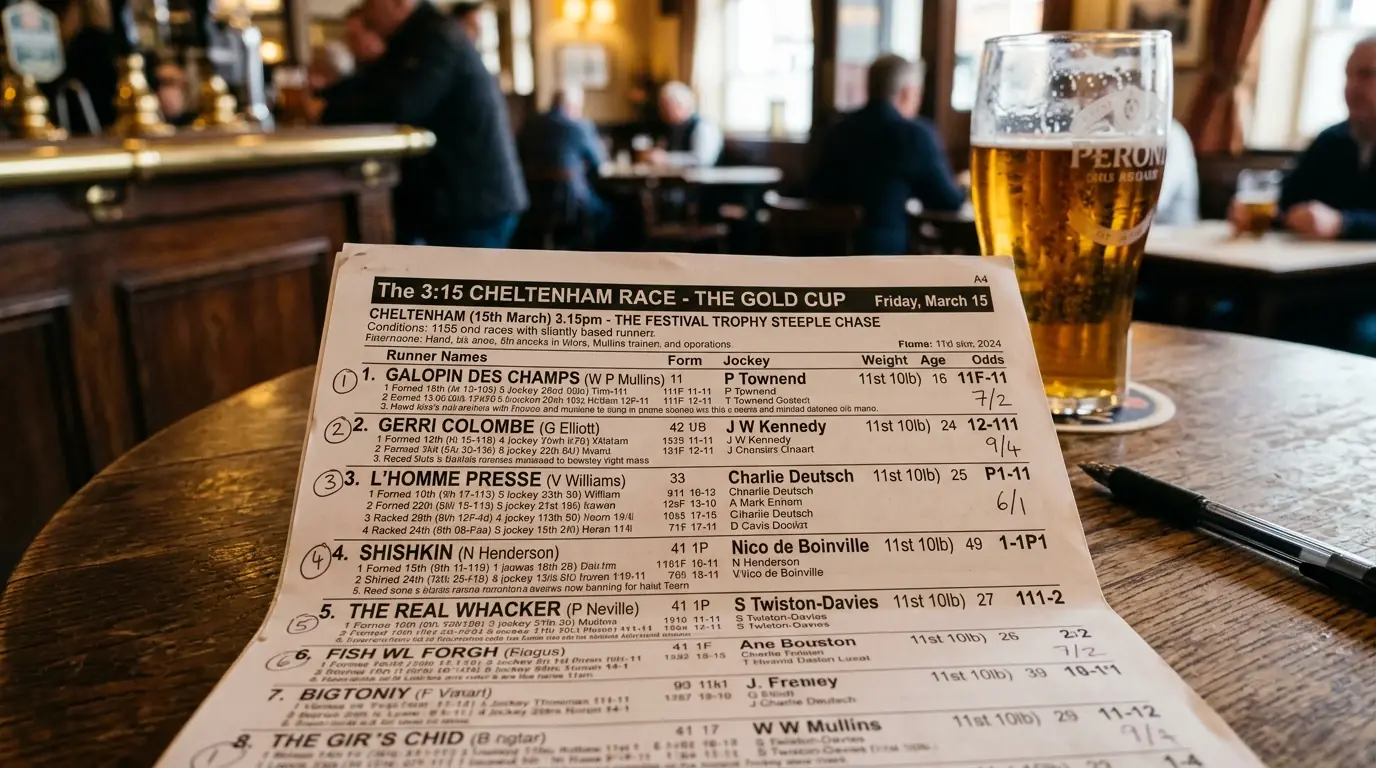
Form figures: numbers and letters showing a horse’s recent finishing positions. The most recent run appears on the right. 0 means outside top 9; F means fell, P pulled up, U unseated, R refused.
Forecast: a bet on the first two finishers in correct order. The Computer Straight Forecast (CSF) is a dividend-based version operated by the Tote.
Fractional odds: the traditional British format. 7/2 means £7 profit for every £2 staked. Divide left by right and add one for the decimal equivalent.
Going: the official description of ground conditions. Firm, Good-to-Firm, Good, Good-to-Soft, Soft, Heavy on turf. All-weather uses Standard variants.
Group race: the highest class of flat races. Group 1 is the top tier; Group 2 and 3 follow. National Hunt uses an equivalent Grade structure.
Handicap: a race where horses carry weights determined by their official ratings. UK handicap favourites win about 25.7% of races.
Hold-up horse: a horse who races near the back of the field early, depending on a fast pace and clear racing room to make ground in the closing stages.
Hurdle: a National Hunt race over smaller obstacles, typically three and a half feet high.
Implied probability: the percentage chance of winning implied by a price. One divided by decimal odds, multiplied by 100. 4.00 implies 25%.
In-running: betting placed while a race is in progress. Exchange prices in-running update continuously.
Laying: taking the other side of a back bet on an exchange — accepting money on a horse to lose. Lay liability equals (back stake) × (odds − 1).
Levy: the statutory contribution from UK gambling operators to the Horserace Betting Levy Board, funding prize money, integrity services and infrastructure. The 2024-25 collection reached a record £108.9 million.
Longshot: a horse priced at long odds, typically 10/1 or longer. The favourite-longshot bias means longshots are systematically overpriced relative to actual win rates.
M–R: Maiden to ROI
The third band covers race types, racing concepts and the analytical measures that serious punters use to evaluate their own performance.
Maiden: a horse that has not yet won a race. Maiden races are restricted to maidens, with novice-equivalent categories in National Hunt.
National Hunt: jumps racing — hurdles, chases and bumpers. The season runs October to April with major action between Christmas and the Cheltenham Festival in March.
Nap: a tipster’s strongest selection of the day. Tipsters typically also identify a “Next Best” (nb).
Non-Runner No Bet (NRNB): a concession on ante-post markets where stakes are refunded if the horse doesn’t run.
Novice: a horse that has not won under a specific code or at a specific level. UK novice favourites win approximately 33% of races.
Odds-against: prices longer than evens — the horse loses more often than it wins, in the market’s view.
Odds-on: prices shorter than evens. A 1/2 favourite returns £1 profit on a £2 stake.
Overround: the bookmaker’s built-in margin, the sum of implied probabilities across all runners. UK bookmaker overrounds typically sit at 110 to 125%; exchange overrounds at 102 to 105%.
Pace: the speed at which early stages develop. Fast pace favours closers; slow pace favours front runners.
Patent: a 7-bet combination across three selections — three singles, three doubles and a treble.
Place: finishing within qualifying positions for each-way payout. Top 2 in fields of 5-7, top 3 in fields of 8-15, top 4 in big-field handicaps.
Punter: a person who places bets. Equivalent of “bettor” in American usage.
Racecard: the published list of runners for a race, with form figures, weights, jockeys, trainers and prices.
Refused: a National Hunt term for a horse that stops in front of an obstacle without attempting to jump. Indicated by “R” on form figures.
ROI (Return on Investment): total profit divided by total stakes, expressed as a percentage. Backing every UK favourite at level stakes returns roughly 93% — an ROI of minus 7%.
S–Z: Steamer to Yield
The final alphabetical band closes the glossary with the market-movement terminology, exchange-specific concepts and performance metrics that recur throughout serious analytical work.
SP (Starting Price): the official price at race-off, agreed by a panel reviewing the on-course bookmaker market. The reference point for many concessions and pre-race settlements.
Stalker: a horse who tracks the early leader two or three lengths behind. Tactically flexible — can move forward or settle further back.
Stayer: a horse who excels at longer distances. Stayers benefit structurally from races run at pace that tests stamina.
Steamer: a horse whose price shortens significantly before the race, indicating substantial market support. The opposite of a drifter.
Strike rate: winners divided by total selections. Only meaningful alongside average odds — 30% at average 8/1 is exceptional; the same at average 5/4 indicates loss.
Tipster: a person who publishes selections, typically for subscribers. Tipster performance should be evaluated by level-stakes ROI across 500+ bets rather than headline strike rates.
Tongue tie: a strip of cloth or rubber preventing a horse’s tongue from impeding breathing. First-time tongue ties are noted on the racecard and sometimes signal improvement.
Treble: a three-leg accumulator. All three selections must win.
Tricast: a bet predicting the first three finishers in correct order. The Computer Tricast (CTC) operates as a Tote dividend across most UK races.
Trip: the distance of a race. Horses have preferred trips that suit their action and stamina.
Turf: grass racing surface. Most UK flat racing takes place on turf during summer.
Unseated rider: when a jockey is dislodged from the horse without the horse falling. Indicated by “U” on form figures, distinct from “F” (fell).
Win-only: a bet where the horse must finish first to pay.
Yankee: an 11-bet combination across four selections — six doubles, four trebles and one four-fold. Two winners produces a return; four winners pays the full structure.
Yield: profit per pound staked, calculated similarly to ROI. For level-stakes win-only betting, ROI and yield converge.
This glossary covers the core working vocabulary of UK racing. The terms blend across categories — handicap, going, draw, form — into the integrated analytical language serious punters use without thinking. For beginners working through the language for the first time, my full guide to horse racing betting for beginners UK walks through the practical first steps in placing bets and reading racecards.
The Betfair Exchange terminology around back, lay, BSP and matched bets sits at the structural heart of modern UK racing markets, where new bets match approximately every 50 seconds in active pre-race markets with average participation around 9.86 punters per market.
What does ‘nap’ mean in horse racing tips?
A nap is a tipster’s strongest selection of the day, identified with the highest confidence rating. Most tipsters publish a daily nap alongside a Next Best (nb) which is their second strongest pick. The term comes from the card game Napoleon, where calling ‘nap’ means betting on winning all five tricks. In racing, calling a nap signals the tipster is putting their reputation behind one specific horse for that day’s racing.
What is the difference between SP and BSP?
SP (Starting Price) is the official fixed-odds price at race-off time, agreed by a panel reviewing the on-course bookmaker market. BSP (Betfair Starting Price) is the exchange equivalent, calculated from matched volume across the Betfair Exchange at the moment the race starts. BSP typically returns prices slightly better than SP because the exchange overround is dramatically narrower (102 to 105% versus 110 to 125% at bookmakers), meaning less of the punter’s stake is absorbed by structural margin.
Published by the Horse Racing bet Strategy team.