Horse Racing Betting for Beginners: A Step-by-Step UK Guide
 Available in US

My first bet on a horse was a £5 each-way punt on something called Snurge in the 1991 St Leger. I picked it because I liked the name. It won at 7/1, I collected £45, and I spent the next twenty years thinking horse racing was easy. It wasn’t. The lesson took a while to land.
If you’re reading this, you’re somewhere near where I started. You’ve maybe watched a Grand National, fancied the look of the Cheltenham Festival, or simply noticed that racing is the second-largest spectator sport in the UK by attendance, employment and revenues — and you want to know how to actually get involved without making expensive mistakes.
This guide is what I’d tell my younger self over a pint. It covers the difference between flat racing and National Hunt, exactly how to place your first bet (online or on-course), how to read a racecard without your head spinning, and a simple selection process you can use this weekend.
Flat vs National Hunt: Choosing Your First Races
Newcomers often don’t realise British racing is essentially two different sports sharing the same horses. Picking the right one to start with will save you a lot of bewilderment.
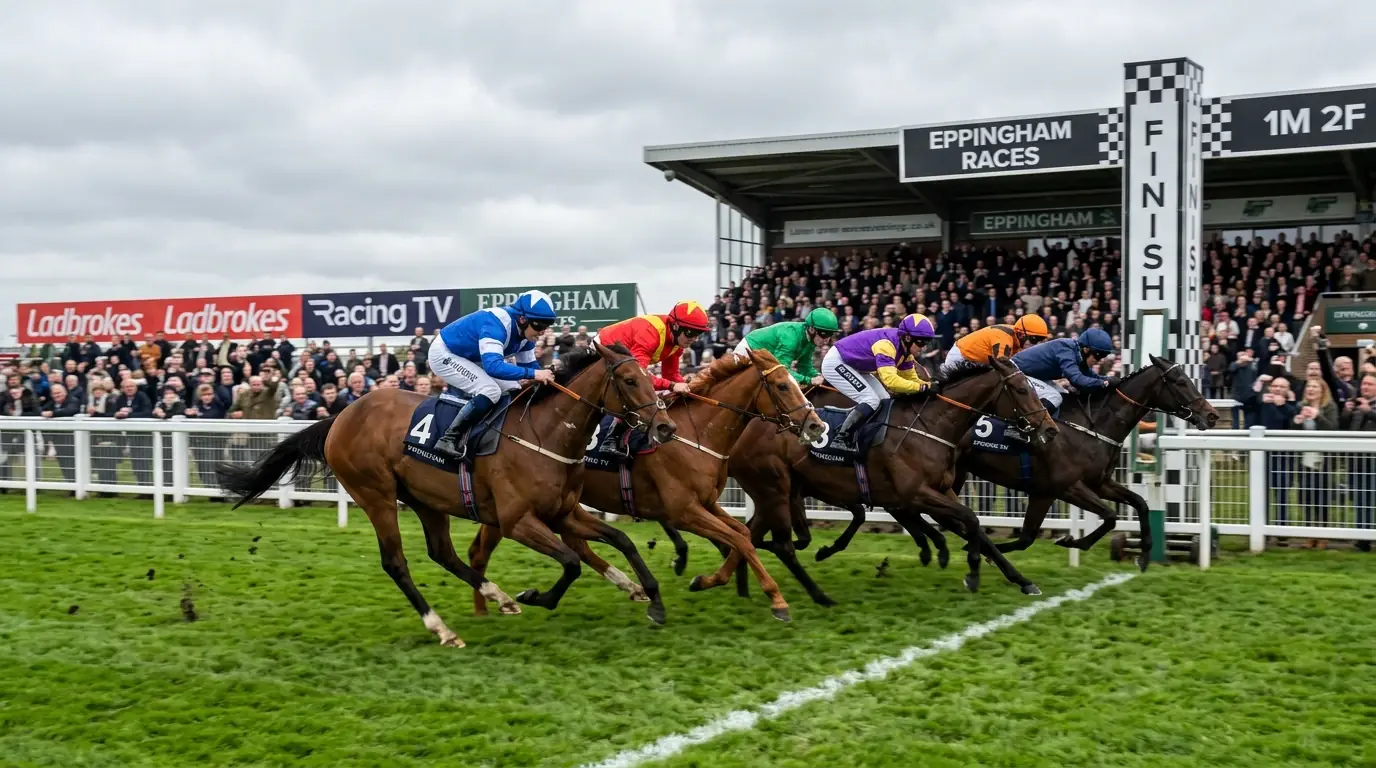
Flat racing is what it sounds like: horses run on level turf or all-weather surfaces, no obstacles, distances from five furlongs (about a kilometre) to two and a half miles. The flat turf season runs roughly from late March to early November. The horses are typically younger, faster, and the races shorter — most flat races are over in 90 seconds to two minutes. It’s the code of Royal Ascot, Glorious Goodwood, the Derby. If you like a quick verdict and clean lines, flat racing suits you.
National Hunt is racing over jumps. Hurdles are smaller obstacles, around three and a half feet high. Chases are bigger fences, four and a half feet plus, with ditches and water jumps thrown in. The season is winter-weighted (October to April, with summer jumping at a few tracks), the horses are older and tougher, and the races are longer — two miles to four and a quarter miles for the Grand National. National Hunt is more dramatic, more weather-dependent, and arguably easier to follow as a beginner because you have more time to spot what’s happening in the race.
My honest advice for a first-timer: start with National Hunt. The races last long enough that you can actually watch what’s going on. Form figures matter slightly less because stamina and jumping ability create more upsets, which means cheaper learning experiences. And the season aligns with cold winter Saturdays when there’s nothing else to do.
That said, if you’re going to be drawn into the sport by a big day, the Cheltenham Festival in March and Royal Ascot in June are the gateway drugs. Royal Ascot alone drew five million TV viewers across five days in 2025. Pick one of those festivals as your introduction and you’ll be hooked or repelled within the week.
How to Place Your First Bet Online and On-Course
Forget any image you have of bowler-hatted bookies and pencilled ticker tape. Modern bet placement, online or on-course, is much simpler than it looks from outside.
Online is where most beginners will start. The process is roughly: open an account with a UK-licensed bookmaker (the licence number should be visible at the bottom of their homepage), verify your identity with a passport or driving licence, deposit a small amount with a debit card, and you’re ready. UK regulation requires affordability and identity checks, so don’t be surprised if you’re asked for payslips or bank statements when you start betting larger sums — these aren’t optional and they apply industry-wide.
To place a bet online, navigate to today’s UK racing, pick a race, click on a horse’s price, enter your stake in the bet slip, and confirm. The slip will show you the total return if your selection wins. Most sites let you choose between win-only (the horse must win), each-way (split between win and place — more on that in a moment), or various multiples. For your first month, stick to win-only or each-way singles. Skip the accumulators, the request-a-bet offers, the in-play markets. They’re harder than they look.
On-course betting is a different experience entirely, and I’d encourage every new punter to try it at least once. You’ll find Tote windows (a pari-mutuel system where all bets go into a pool), high street bookmaker outlets at the track, and the on-course bookmakers — the ones standing on boxes with boards and a clerk. To bet with a course bookie, just walk up, state the horse and stake clearly (“£10 win, number 7”), hand over your money, and take the ticket. Keep it safe — that ticket is your only proof of bet. If your horse wins, you return to the same bookmaker after the race to collect.
The minimum bet at most UK on-course bookmakers is £2, sometimes £5 in the Royal Enclosure at Ascot. Online minimums are typically much lower, often pennies. Don’t let small minimums tempt you into firing off dozens of bets — that’s a quick route to losing track of your spend.
Making Sense of the Racecard at a Glance
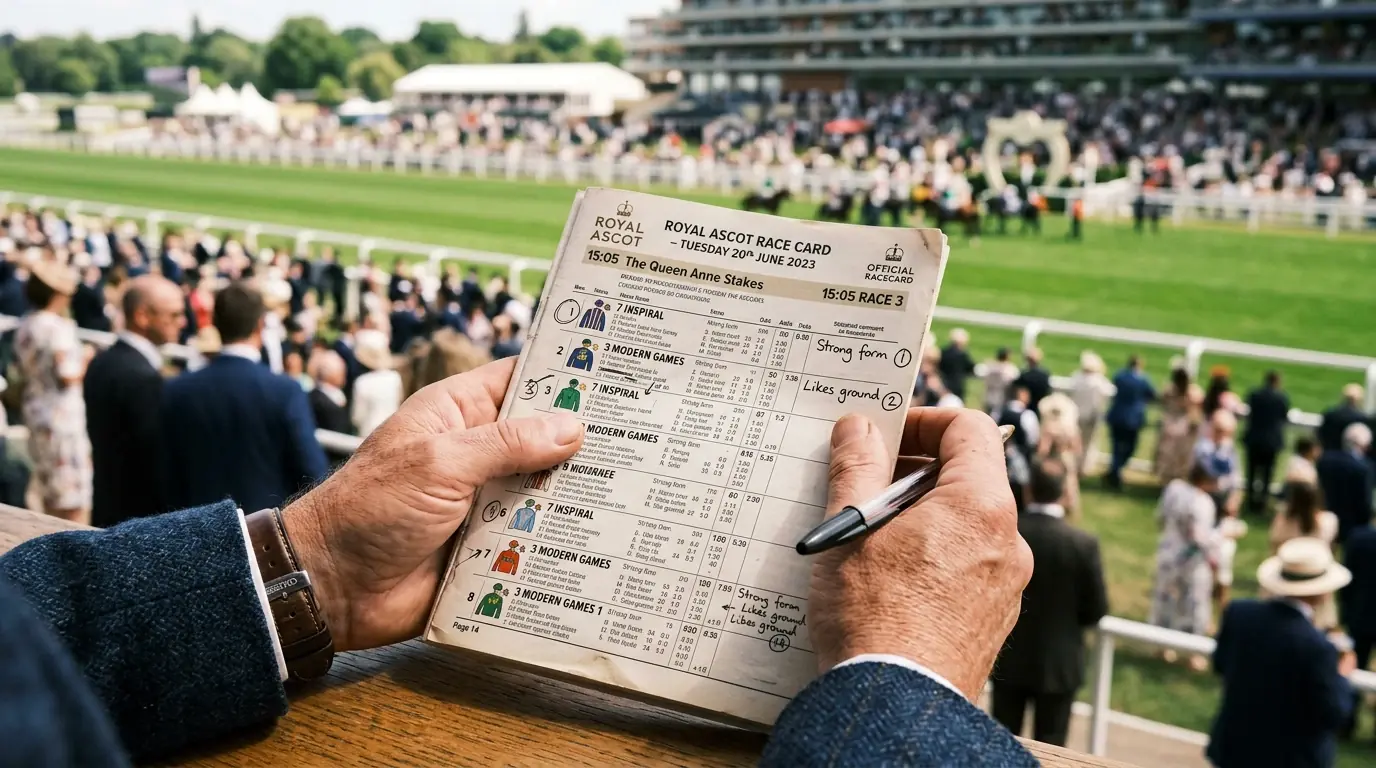
The racecard is where every new punter feels overwhelmed for about twenty minutes, then it clicks. The format is consistent across the Racing Post, Timeform, and most online operators, so once you’ve decoded one you’ve decoded them all.
Each runner gets a row. From left to right, you’ll see: the saddlecloth number (also called the cloth or runner number), the draw (only relevant for flat races, indicating the starting stall), recent form figures, the horse’s name, age and weight carried, the jockey’s name, the trainer’s name, and the current price. Below the row, you may see a brief comment, the horse’s most recent results, the trainer’s recent strike rate, and any equipment changes like blinkers or a tongue tie.
Form figures are the most useful single column for a beginner. They read most recent on the right. So “12P4-3” means: most recent run was third, separated by a dash (which indicates a new season), prior run was a pulled-up, then a fourth, then a win in the run before that, and a second the time before. The number 0 means finished outside the top nine. The letter F means fell, P means pulled up, U means unseated, R means refused. A horse that has shown recent form figures of 1, 2, or 3 is your friend. A horse with multiple Fs, Ps, or 0s is usually not.
The going (ground condition) sits at the top of every card. Firm and Good-to-Firm are dry summer conditions. Soft and Heavy mean wet, deep ground that suits stamina horses. Most horses have a preferred going, and that preference is usually visible in their form. A horse with all its wins on Soft ground running on Firm is fighting against itself.
A Simple Selection Process for Your First Bets
If you take one thing from this guide, take this. For your first month, use a five-step process and nothing else. Discipline beats genius every single time when you’re learning.
Step one: pick a race. Not all races. One race. Maybe two. Beginners who try to bet on every race on the card lose because they end up betting horses they don’t understand to chase action. Pick the feature race or the most competitive handicap of the day.
Step two: read every horse’s form figures and recent results. Eliminate anything that hasn’t finished top three in its last three runs unless there’s a clear excuse (returning from injury, running over the wrong trip, unsuitable going). You’ll be down to a shortlist of three or four horses from a 12-runner field.
Step three: check the going preference. If today’s ground is Soft and your shortlist contains a horse whose only wins are on Good-to-Firm, cross it off. If you’re left with two horses, even better.
Step four: check the price. UK favourites win roughly 30 to 35% of races, second favourites about 20%, third favourites about 12 to 15%. The top three in the betting collectively win 65 to 70% of races. If your shortlist horse is in the top three in the market and has a clean form and ground profile, you’ve identified a credible contender. If it’s the rank outsider of your shortlist, you may be looking at a value bet rather than the likely winner.
Step five: place a small stake. I mean small. £5 to £10 maximum for your first month. The point is to learn, not to earn. Track every bet in a notebook or a phone note: race, horse, stake, odds, result. After 30 bets you’ll know more about your own decision-making than any guide can teach you. When you’re ready to go deeper, my guide to horse racing form analysis walks through how to extract more signal from a racecard than the basic figures alone reveal.
Common Mistakes I Wish I’d Avoided
Two things will sink most new punters within their first three months, and neither has anything to do with picking horses.
The first is staking too much because a result felt obvious. Confidence is the most expensive emotion in betting. Every horse can lose. The 4/7 favourite that “couldn’t possibly get beaten” gets beaten roughly two times in five. Stick to small, level stakes for at least 50 bets before you let conviction influence your sizing.
The second is betting on races you don’t understand because you’ve already opened the app. There’s always another race tomorrow. If today’s card looks awkward — too many novices, contradictory form, weather changes — close the app and walk away. The professionals I know in the British racing scene bet far fewer races than the public assumes. They wait for the situations they understand and pass on everything else. You should too.
What is the minimum bet I can place on UK horse racing?
Online, minimums are usually very low — often 10p or less per selection, depending on the operator and the bet type. On-course bookmakers typically set a £2 minimum, rising to £5 or £10 at premium enclosures. The Tote has historically allowed bets from £1 upwards on most pools.
Should beginners start with win bets or each-way bets?
Win-only is simpler and easier to learn from. Each-way splits your stake into a win bet and a place bet, which doubles the cost but pays out if your horse finishes in the top two, three or four depending on field size. For your first month, stick to win bets so you can clearly judge whether your selections are working. Add each-way once you understand when place terms genuinely add value.
Prepared by the Horse Racing bet Strategy editorial staff.