Horse Racing Odds Explained: Fractional, Decimal and Implied Probability for UK Punters
 Available in US

The first time I stood at the rail at Newmarket and tried to read a bookmaker’s board, I felt like I’d walked into a maths exam I hadn’t revised for. 6/4, 11/2, 100/30 — the numbers looked like a foreign language. Nine years later, I can convert any odds format in my head in about two seconds, and I want to walk you through exactly how that becomes second nature.
Odds are not just a price. They’re a statement about probability, dressed up in betting industry tradition. Once you see through the fractions and decimals to the implied probability underneath, you stop placing bets and start making investment decisions. That shift is the single most important thing a new punter can learn.
In this guide I’ll show you how fractional odds work, why decimal odds are quicker for calculations, how to convert any price into a probability percentage, and — crucially — what the bookmaker’s overround actually costs you across a typical UK racecard.
How Fractional Odds Work
Fractional odds are a British peculiarity, and I’d argue they’re the reason a lot of casual punters never quite get to grips with what they’re betting on. Walk past a high street bookmaker’s window and you’ll see prices like 7/2, 9/4, 11/10 — pure tradition, dating back to a time when betting was done with chalk on slate.
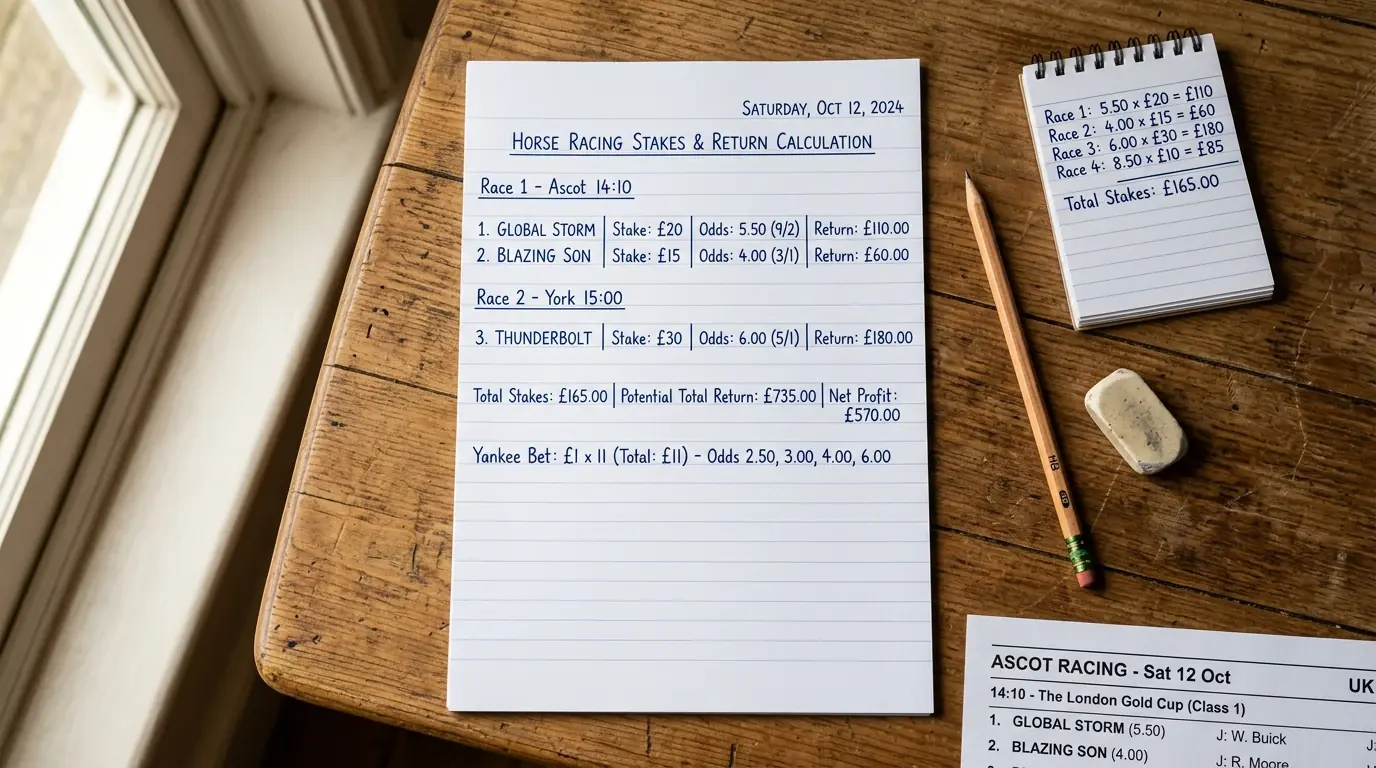
The format is simple once you decode it. The number on the left is your profit; the number on the right is your stake. A horse priced at 7/2 means you win seven pounds for every two you stake — plus your stake back. So a £10 bet at 7/2 returns £45 in total: £35 profit and your tenner back in your hand.
Where it gets messy is the irregular fractions. 11/4, 100/30, 13/8 — these are not numbers you’d ever see in a maths textbook, but they’re standard in British racing. The reason is that bookmakers historically moved prices in tick increments tied to the betting ring’s traditions, and those increments stuck. To convert any fractional price into pounds returned per pound staked, divide the left number by the right and add one. So 11/4 becomes 2.75 + 1 = 3.75. That’s the decimal equivalent.
Odds-on prices reverse the relationship. When you see 4/6 or 1/2, you’re being told the horse is strong favourite. A 1/2 shot means you risk two pounds to win one — a £20 stake returns £30 total: £10 profit plus your stake. The numbers are simply flipped because the horse is more likely to win than lose. In the UK around 59% of odds-on favourites win on flat turf, which sounds generous until you realise the maths still doesn’t favour blanket backing.
The shorthand “evens” or “Evs” means 1/1. Your stake doubles if you win. You’ll hear it called “level money” in older racing circles. It’s the pivot point between odds-against (the horse loses more often than it wins, in the market’s view) and odds-on (the reverse).
Decimal Odds and Quick Conversion
Decimal odds are what I use for every actual calculation, and so does almost everyone serious about value. Exchanges like Betfair display decimals as standard. Most online bookmakers let you switch your display from fractional to decimal in the account settings, and I’d recommend doing it within five minutes of opening an account.
The format is brutally efficient. A decimal price represents your total return per pound staked, including your stake. 3.50 means £3.50 back for every £1 you put on. To get profit only, subtract one: 3.50 minus 1.00 equals 2.50 profit per pound.
Converting fractional to decimal in your head: divide the left number by the right, add one. 5/2 becomes 2.5 + 1 = 3.50. 9/4 becomes 2.25 + 1 = 3.25. 11/10 becomes 1.10 + 1 = 2.10. The maths is mechanical, and after a week or two of doing it you’ll stop noticing you’re doing it.
The reason decimals matter for serious punters is that they let you compare prices across formats instantly. If a bookmaker offers 7/4 and an exchange shows 2.95, which is the better price? In fractional terms that’s 1.75 versus 1.95 profit per pound — but it’s far quicker to see that 2.75 (the decimal equivalent of 7/4) is lower than 2.95. Across hundreds of bets in a season, the punter who shops for an extra few pence per pound is the punter who finishes ahead.
One quirk worth flagging: decimal odds always show one or two decimal places, but exchanges quote to two decimal places routinely. The difference between 4.10 and 4.20 looks small, but on a £20 stake that’s an extra £2 in your pocket. Multiply that across a year of selections and the gap becomes very real.
Turning Odds into Implied Probability
This is the bit that changed my approach to betting more than any single piece of analysis I ever did. Every price implies a probability — a percentage chance that the bookmaker (or the market) thinks the horse will win. If you don’t know what probability you’re being offered, you can’t possibly know whether the price is value.
The formula is straightforward. Implied probability equals one divided by the decimal odds, multiplied by 100 to get a percentage. So 3.00 (or 2/1) implies a 33.33% chance of winning. 4.00 (3/1) implies 25%. 6.00 (5/1) implies 16.67%. 11.00 (10/1) implies 9.09%.
Once you internalise this, you start asking a different question at the bookmaker’s window. Not “do I think this horse will win?” but “do I think this horse has a better than 25% chance of winning at 3/1?” That second question is the entire game.
Favourites in the UK win roughly 30 to 35% of races overall, dropping to about 25.7% in handicaps and rising to around 33% in novice races. So when you back a 6/4 favourite (40% implied probability) in a handicap, you’re betting that this specific horse outperforms the average favourite by a meaningful margin. Sometimes that’s true. Often it isn’t. The implied probability is your reality check.
This is why I keep a small mental table of common conversions at the front of my mind. 1/2 = 66.7%. Evens = 50%. 6/4 = 40%. 2/1 = 33.3%. 3/1 = 25%. 5/1 = 16.7%. 10/1 = 9.1%. 20/1 = 4.8%. With those landmarks, I can instantly judge whether a price feels fair before I even open the form. If you want to go deeper on this kind of probability work, my breakdown of value betting in horse racing walks through how to estimate your own true probability and compare it against the market.
The Bookmaker’s Overround and What It Costs You
Here’s the part no bookmaker advertises. Add up the implied probabilities of every runner in a race. In a fair market, they’d sum to 100% — because exactly one horse must win. In a real UK racing market, they sum to somewhere between 110% and 130%. That extra percentage is called the overround, and it is the bookmaker’s margin baked into every single price you see.
Let me show you why this matters. Imagine a four-runner race priced at 2/1, 3/1, 4/1, and 5/1. The implied probabilities are 33.3%, 25%, 20%, and 16.7%. Add them up: 95%. That would be a market with negative margin — the bookmaker would lose money long-term. So in reality the same four horses might be priced at 7/4, 5/2, 7/2, and 4/1. Now the probabilities are 36.4%, 28.6%, 22.2%, and 20% — totalling 107.2%. That 7.2% is what the bookmaker keeps, on average, no matter who wins.
The bigger the field, the bigger the overround tends to be. A 16-runner handicap on a busy Saturday might carry an overround of 125% or worse. Across the UK’s £766.7 million remote betting market on horse racing in the 2024-25 financial year, that margin adds up to enormous sums. It’s also why backing every horse in a race — no matter what the prices — is a guaranteed loss.
The practical takeaway is this: shopping for best prices isn’t optional. It’s the only way to claw back some of that built-in margin. Best Odds Guaranteed, exchange prices, early-morning bookmaker concessions — these aren’t extras, they’re the difference between a 5% loss rate and a 12% loss rate over a full year of betting. And on stake sizes that matter, that gap is your entire profit margin.
Reading Odds in Context
Odds tell you what the market thinks. They don’t tell you what’s true. The most valuable skill in UK racing isn’t memorising conversion tables — it’s developing a sense for when the market has got something wrong.
That sense comes from doing the conversion every single time, without fail. When you see 11/2 in the morning paper, immediately translate it: 6.50 decimal, 15.4% probability. When you see that same horse drift to 7/1 by post time, you can instantly recognise the market has revised its view downward by about 3 percentage points. When you see it come in to 4/1, the market has it as a roughly 5% more likely winner than it did this morning. These shifts mean something. They reflect money entering the market, late stable whispers, last-minute going changes — information you may not have, but the market does.
The overround means you can never simply mirror the market and win. You need an edge — a reason to believe the true probability is higher than the implied probability after accounting for the bookmaker’s cut. That’s the foundation of every profitable approach to UK horse racing, and it starts with understanding exactly what the numbers on the board are telling you.
Spend a fortnight running every price you see through the implied-probability conversion before you place a bet. Within a month it will be automatic. Within three months you’ll be wondering how you ever bet without it.
What does odds-on mean in UK horse racing?
Odds-on means the horse is shorter than evens, so you risk more than you stand to win. A 1/2 favourite returns £1 profit on a £2 stake — the market judges the horse more than 50% likely to win. In UK flat turf racing, odds-on favourites win around 59% of the time, which sounds attractive until you factor in the cumulative cost of losses on the 41% that don’t oblige.
How do I convert fractional odds to decimal quickly?
Divide the left number by the right, add one. So 7/2 becomes 3.5 plus 1 equals 4.50. 9/4 is 2.25 plus 1 equals 3.25. Evens is 1 plus 1 equals 2.00. Once you’ve done this fifty times the conversion happens before you’ve consciously thought about it.
Why do the odds on all runners in a race add up to more than 100%?
That extra percentage is called the overround, and it’s the bookmaker’s built-in profit margin. A typical UK race carries an overround of 110% to 130%, meaning the prices on offer collectively imply more total probability than exists. The difference between that total and 100% is what the bookmaker keeps on average, regardless of who wins.
Written by the editors at Horse Racing bet Strategy.