Value Betting in Horse Racing: How to Calculate Edge and Find Overlays
 Available in US
I spent my first three years betting on horses chasing tips. Somebody on a forum swore blind a horse was a certainty at Kempton, I lumped on, and it finished sixth. The next week, same routine, different tipster, same result. It took me an embarrassingly long time to realise the problem was not the tips — it was that I had no framework for deciding whether a price was actually worth taking. I was betting on opinions, not probabilities.
The shift happened when I started thinking about every wager as a transaction with a measurable expected return. Backing a horse at 5/1 is not inherently good or bad — it depends entirely on whether that horse wins more or less often than one time in six. That single insight separates punters who grind a profit over thousands of bets from the majority who slowly donate their bankroll to the bookmaker. Flat staking on favourites across UK racing returns roughly 93p in every pound, a steady bleed of about 7% — and the further down the market you go, the worse it gets, with third favourites returning around 85p. Those numbers are not a death sentence for betting. They are the starting point for value betting: the discipline of finding spots where the market has priced a horse below its true chance of winning.
This guide breaks down exactly how I assess value in UK horse racing markets, from the expected value formula to building tissue prices, reading market moves, and exploiting the structural inefficiencies that bookmakers and exchanges leave open. If you are serious about making your betting sustainable, this is where it starts.
What Value Means in Horse Racing Markets
Every bookmaker price carries an implied message: “We think this horse has roughly this chance of winning.” When you back a horse at 4/1, the bookmaker is implying it wins about 20% of the time. Value exists when you believe — with evidence, not gut feeling — that the horse actually wins more often than the price suggests. If your assessment says 25% and the market says 20%, you have an overlay. Back enough overlays at a large enough edge, and the mathematics tilt in your favour over hundreds of bets.
The legendary American horseplayer George E. Smith, known as “Pittsburg Phil,” put it bluntly over a century ago: you cannot be a successful horse player if you are going to get the worst of the price all the time. He was talking about value before the word entered betting vocabulary. The concept is identical whether you are punting at Ascot in 2026 or betting from a grandstand in 1890s New York — the price must overstate the horse’s chance of losing for you to have an edge.
Value is not about picking winners. I know punters with a 40% strike rate who lose money because they back short-priced favourites that are over-bet. I also know punters with a 15% strike rate who turn a steady profit because every winner lands at a price that more than compensates for the losers. The metric that matters is not how often you win but whether your winners pay enough to cover the losing bets and leave a margin. That margin is your edge, and it is the only thing separating a profitable bettor from an entertained one.
One distinction worth making early: value is not the same as a big price. A 33/1 shot can be terrible value if its true chance is 50/1. A 6/4 shot can be outstanding value if it should be odds-on. The odds themselves tell you nothing until you compare them to your own probability estimate. Building that estimate is the skill; recognising when the market disagrees with you in your favour is the discipline.
Calculating Your Edge: The Expected Value Formula
I remember the first time I sat down and actually calculated expected value on a bet rather than just eyeballing the price. It felt clunky, almost academic — but within a month it had changed how I saw every race. The formula is simple. Expected Value equals the probability of winning multiplied by the net profit if you win, minus the probability of losing multiplied by the stake lost. In practical terms: EV = (P(win) x Profit) – (P(loss) x Stake).
Say you rate a horse as having a 25% chance of winning and the available price is 5/1. A one-pound stake returns five pounds profit if it wins. EV = (0.25 x 5) – (0.75 x 1) = 1.25 – 0.75 = +0.50. For every pound you stake at those terms, you expect to make 50p over the long run. That is a massive edge — you will rarely find anything that generous in a liquid market. A more realistic scenario: you rate a horse at 30% and the price is 3/1. EV = (0.30 x 3) – (0.70 x 1) = 0.90 – 0.70 = +0.20. Twenty pence per pound is still a healthy edge, one that any professional would take repeatedly.
Negative EV works the same way in reverse. If you rate a horse at 20% and back it at 3/1, EV = (0.20 x 3) – (0.80 x 1) = 0.60 – 0.80 = -0.20. You are donating 20p per pound to the market every time you take that bet. Most casual punters take negative EV bets constantly without realising it, because they never calculate their own probability — they just like the horse.
The formula depends on one input you control: your probability estimate. Get that wrong and the entire calculation collapses. This is why value betting is not a shortcut. It demands that you develop genuine skill at assessing a horse’s chance — through form analysis, going conditions, class, pace maps, whatever tools fit your approach. The expected value formula is just the lens through which you convert that assessment into a clear bet or pass decision.
Converting Odds to Implied Probability
Before you can spot an overlay, you need to translate what the bookmaker is offering into a probability. For fractional odds, the conversion is straightforward: implied probability = denominator / (numerator + denominator). At 4/1, that is 1 / (4 + 1) = 0.20, or 20%. At 7/2, it is 2 / (7 + 2) = 0.222, or 22.2%. For decimal odds, it is even simpler: 1 / decimal odds. Decimal 5.0 gives 1 / 5.0 = 0.20, or 20%.
Here is where it gets interesting. If you add up the implied probabilities of every runner in a race, the total will exceed 100%. The surplus is the overround — the bookmaker’s built-in margin. A typical UK handicap might have a book percentage of 115-120%, meaning you are effectively paying a 15-20% tax on top of the true probabilities. Smaller fields tend to have tighter books, sometimes 105-108%. Exchange markets typically run at 101-103% because there is no bookmaker margin, just a small commission on winnings.
Why does the overround matter for value betting? Because each horse’s implied probability is inflated by a share of that overround. A horse showing 4/1 in a 120% book does not have a true implied chance of 20% — the bookmaker has padded it. To strip out the overround, divide the raw implied probability by the total book percentage: 20% / 120% = 16.7%. That adjusted figure is closer to what the market genuinely thinks the horse’s chance is. When your own estimate exceeds that adjusted figure, you have value.
I do this calculation reflexively now, but early on I kept a simple spreadsheet open during every race I analysed. Within a few weeks the conversions became automatic, and I could glance at a set of odds and immediately sense whether the book was tight or bloated — and where the most padding sat in the market.
How to Spot Overlays in UK Racing Markets
Knowing the formula is one thing. Finding actual overlays in a live market is where the money is made or lost. I look for overlays through three main channels: price comparison across bookmakers, exchange vs fixed-odds divergence, and my own tissue price disagreeing with the market consensus.
Price comparison is the simplest starting point. Different bookmakers price the same runner differently because they balance their books based on their own customer base. When one firm offers 7/1 and the rest of the market sits at 5/1, that 7/1 might be an overlay — or it might be a firm that has taken heavy money on other runners and extended the outsider to attract balancing bets. Context matters. But if your own assessment already liked the horse at 5/1, a 7/1 price turns a marginal bet into a clear one.
Exchange prices add another layer. Betfair exchange data shows new bets appearing roughly every 50 seconds in an active UK racing market, with an average of nearly 10 participants per market. That frequency means exchange prices update constantly, and they tend to be sharper than fixed-odds prices because they reflect real money from both sides. When a horse is 4/1 with bookmakers but available to back at 5.5 on the exchange, the gap is your opportunity — and it often appears because bookmakers have not yet adjusted to a market move.
The third method, tissue pricing, is deeper and I cover it in its own section below. But the core principle is the same: you are looking for a gap between what you believe and what the market is offering. The wider the gap, the bigger your edge. The narrower the gap, the more selective you need to be about whether variance and commission still make the bet worthwhile.
Reading Market Moves: Steamers and Drifters
Odds do not sit still. Between the morning prices and the off, a horse’s odds can shift dramatically — and those moves carry information. A steamer is a horse whose price shortens rapidly as money pours in. A drifter is the opposite: the price lengthens because the market is moving away from it. Both movements tell you something about where informed money is going, and both can create value in the right circumstances.
Steamers are easy to spot but tricky to exploit. By the time you notice the price crashing from 10/1 to 6/1, much of the value has already been taken. The punters who profit from steamers are the ones who backed the horse early, before the move started. That requires either your own form analysis flagging the horse independently, or monitoring early-morning exchange activity where sharp money often appears first. If you see a horse being backed steadily on the exchanges from 12.0 to 8.0 before the bookmakers have moved from 10/1, there is a window — but it closes fast.
Drifters interest me more, because they are where contrarian value lives. When a fancied horse drifts from 3/1 to 5/1 without any obvious negative news — the going has not changed, the jockey booking is the same, there is no veterinary report — it often means the market overreacted to early money on a rival. The horse has not changed, but its price has become more generous. Not every drifter is value, but a drifter that you already rated as a 25% chance at 3/1 becomes an even stronger proposition at 5/1.
The trap with drifters is confusing “nobody wants it” with “value.” Sometimes a horse drifts because professionals know something you do not — a poor gallop, a minor setback not yet public. The safest approach is to have your own assessment in place before prices open, then treat the market move as additional data rather than the primary signal.
Building Your Own Tissue Prices
A tissue price is your own set of odds for every runner in a race, compiled before you look at the market. The name comes from the thin tissue paper on which racecourse bookmakers used to write their opening shows. Building your own tissue is the most powerful value-finding tool I use, and it is also the most demanding.
Start with a race you know how to assess. For me, that is usually competitive flat handicaps over six furlongs to a mile, because the form is dense and the variables are quantifiable. I go through the racecard and assign each horse a percentage chance based on recent form, going preference, course suitability, draw position, jockey and trainer data, and class. The percentages must add up to 100% — this forces honest calibration. If you think three horses all have a 25% chance and there are twelve runners, the remaining nine have to share 25% between them, roughly 2.8% each. Does that feel right? If not, adjust until it does.
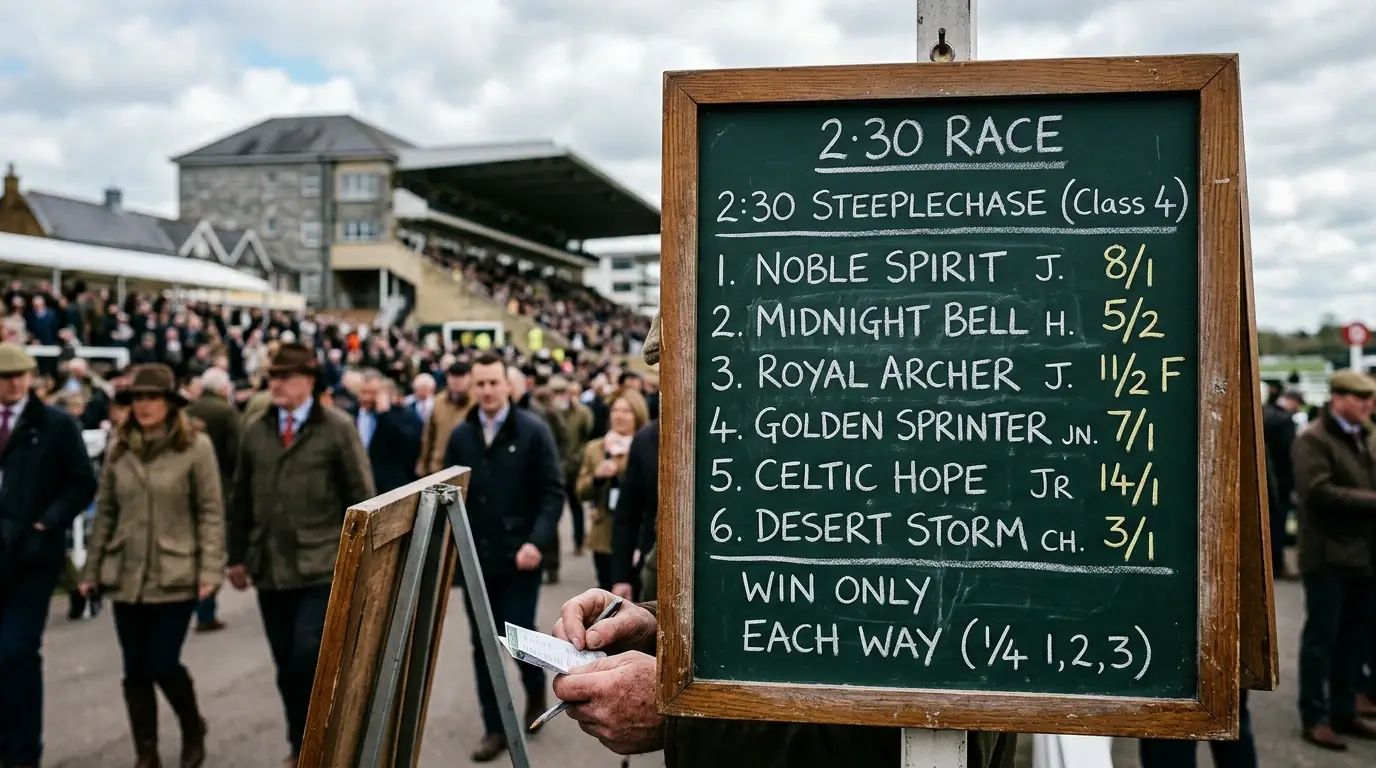
Once you have percentages, convert them to odds. A horse you rate at 25% is effectively a 3/1 shot in your tissue. If the market has it at 5/1, you have a potential overlay. If the market has it at 2/1, it is an underlay and you move on. The discipline is that you must set your tissue before looking at market prices. If you see the odds first, you will anchor to them unconsciously and your tissue becomes a rubber stamp of the market rather than an independent view.
My tissue is wrong more often than it is right on individual runners. That is fine. The goal is not to predict the winner of each race — it is to consistently identify prices that are too big relative to the actual chance. Over hundreds of races, even a modest calibration advantage compounds into profit. I track my tissue accuracy alongside my betting P&L, and the correlation between well-calibrated tissues and positive returns is strong enough that I treat tissue-building as the single most important pre-race task.
One shortcut for punters who find full tissue-building too time-consuming: focus on two or three horses per race rather than the full field. Rate them, convert to prices, then compare to the market. If none of your rated horses show value, skip the race entirely. This partial tissue approach captures most of the benefit with about a third of the effort.
Where Value Hides: Structural Market Inefficiencies
Markets are sharp, but they are not perfect. Structural inefficiencies persist in UK horse racing because of how odds are formed, how money flows, and how the public bets. The best-documented is the favourite-longshot bias: longshots are systematically overbet relative to their true chance of winning, while favourites are slightly underbet. Favourites win around 30-35% of all UK races, and odds-on favourites convert at roughly 59% on the flat. The public overvalues the dream of a big-priced winner and undervalues the grind of backing shorter-priced runners. This bias creates a persistent, small edge for punters who concentrate on the top two or three in the market rather than chasing outsiders.
Handicap races produce a different kind of inefficiency. The BHA handicapper assigns weights to equalise the field, but the ratings lag reality. A horse that has improved since its last run may carry a rating that understates its current ability — it is “well-handicapped” in betting parlance. These horses are value because the market anchors partly to the official rating, while the horse’s actual chance has already moved ahead of it. The window is narrow, usually one or two runs before the handicapper catches up, but that window is where serious money is made in big-field handicaps.
Seasonal patterns create value too. The first two or three weeks of the flat turf season see higher-than-normal levels of mispricing because horses are returning from a winter break with uncertain fitness. Trainers who target early-season races with fresh horses consistently outperform the market during this window. Similarly, the final months of the National Hunt season produce tired horses running below their rating, and the market is slow to price in accumulated fatigue. A structural factor amplifies this: the British horse population is projected to decline 6-7% between 2024 and 2027, a trend Richard Wayman at the BHA has called “the single biggest challenge facing British racing.” Fewer horses mean smaller fields in some races, which concentrates the market and can shift where the mispricing opportunities sit.
Time-of-day effects are underappreciated. The first race on a card often has thinner exchange liquidity and less form to work with, leading to wider price ranges. The last race — especially at an evening meeting — attracts less analytical attention and more recreational money, inflating the odds on runners that have genuine claims. I have found consistent value in final-race handicaps at midweek evening fixtures, precisely because the market is least efficient when the fewest informed punters are paying attention.
Recording and Reviewing Your Value Bets
If you do not record your bets, you cannot know whether your value identification is working. I learned this the hard way. For my first eighteen months of value betting, I tracked nothing. I had a vague sense that I was doing well, but when I finally sat down and reconstructed my results from bank statements, I discovered I had been slightly losing — despite genuinely finding overlays. The leak was not in my selections but in my staking: I was betting too much on marginal value and not enough on strong value.
Every bet I place now goes into a spreadsheet with the same fields: date, course, race time, horse, odds taken, my assessed probability, stake, result, and profit or loss. From these I calculate three numbers on a rolling basis: strike rate (percentage of winners), ROI (total profit divided by total stakes), and average edge per bet (the mean difference between my assessed probability and the implied probability at the odds I took). The top 1% of horse racing bettors in the UK — roughly 60,000 people — generate 52% of all racing betting revenue. Those punters track everything. The other 99% mostly do not.
Monthly reviews are where the tracking pays off. I look for patterns: am I finding more value in handicaps or conditions races? At which courses am I best calibrated? Is my tissue systematically overrating or underrating certain types of horse? Last spring I noticed that my flat sprint assessments were well-calibrated but my staying race tissues were consistently wrong — I was overrating stamina doubts. That single insight, drawn from six months of data, improved my results measurably.
You do not need sophisticated software to do this. A basic spreadsheet works. The critical habit is recording every bet immediately — not at the end of the day, not at the end of the week, but at the moment you place it. Delayed recording invites selective memory, which poisons your dataset. A dedicated tracking system pays for itself within a few months.
Frequently Asked Questions
What percentage edge do I need for value betting to be profitable?
A consistent edge of 3-5% on every bet is enough to generate long-term profit, provided your sample size is large enough and your staking is disciplined. Most professional value bettors target edges of 5-10% on each selection. Below 3%, transaction costs such as exchange commission and the time spent analysing races erode much of the theoretical profit. Above 10% edges exist but are rare and usually come with lower liquidity or higher variance.
How many bets does it take to confirm a positive expected value?
Statistical confidence requires a minimum of 500-1,000 recorded bets at consistent stake sizes before you can draw reliable conclusions about your true ROI. Smaller samples are dominated by variance — a 50-bet winning streak does not prove edge, and a 50-bet losing streak does not disprove it. Track your assessed probability alongside your actual results to see whether your calibration is accurate over the long run.
Can value betting work with bookmaker odds or only exchanges?
Value betting works with both bookmakers and exchanges. Bookmaker odds sometimes offer bigger overlays because different firms price markets differently, and Best Odds Guaranteed promotions can add further value. Exchanges offer sharper prices overall and no risk of account restrictions for winning. Many value bettors use both: bookmakers for early prices and BOG opportunities, exchanges for larger stakes and in-running markets.
How do I account for the overround when assessing value?
Add up the implied probabilities of every runner in the race to calculate the total book percentage. Divide each horse’s raw implied probability by that total to strip out the bookmaker’s margin. Compare your own assessed probability to the adjusted figure rather than the raw one. In a 115% book, a horse at 4/1 has a raw implied probability of 20% but an adjusted probability of roughly 17.4% — meaning you need to rate it above 17.4%, not 20%, for it to represent value.
Created by the ”Horse Racing bet Strategy” editorial team.